
Exhausted All Day, Wired at Night

You wake up tired.
You push through the day.
You tell yourself you’ll finally rest tonight.
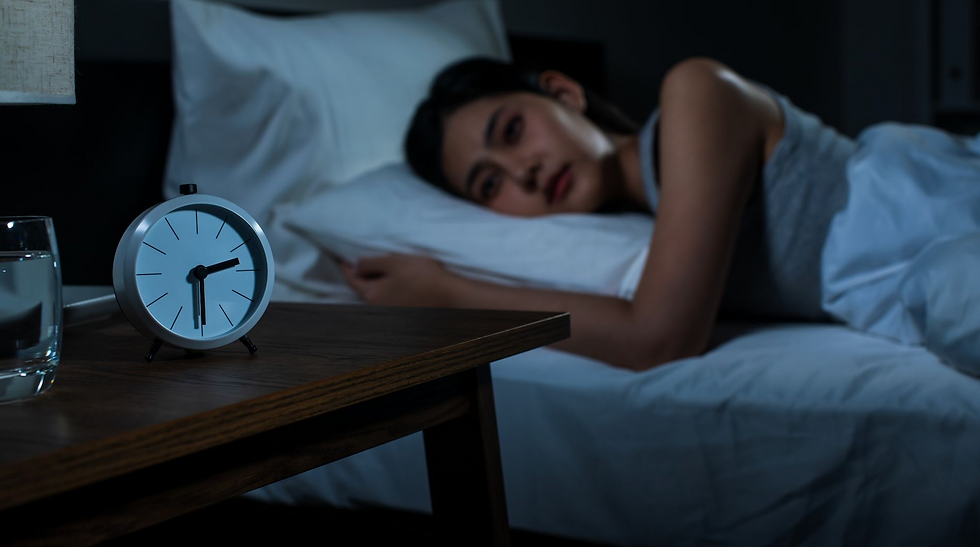
And then… your body won’t shut off.
If that’s you, I want to be very clear:
This isn’t insomnia.
It isn’t resistance.
And it isn’t your body failing you.
It’s a reversed stress rhythm.
When Cortisol Peaks at the Wrong Time
Cortisol is meant to peak in the morning to help you wake up and gradually decline throughout the day so melatonin can rise at night.
Under chronic stress, that rhythm can become disrupted.
Skipped meals, late caffeine, constant stimulation, and evening screen exposure all signal continued demand to the nervous system. Instead of winding down, the body stays vigilant. Cortisol remains elevated later in the day, delaying the rise of melatonin and the onset of sleep (Van Dalfsen & Markus, 2018).
So you wake up depleted.
You push through the day.
And when the environment finally quiets, your system releases energy — not because you’re rested, but because it finally perceives safety.
This response is learned, not chosen.
Why Nighttime Alertness Is Not Insomnia
When exhaustion and alertness exist at the same time, it’s a sign that stress hormones are still active.
Cortisol promotes vigilance. Melatonin supports sleep onset. These hormones work in opposition and are regulated by both circadian rhythms and perceived safety (Goldstein & Walker, 2014).
If your body has learned that nighttime is still a period of threat or unpredictability, it will stay alert — even when you are deeply tired.
This is not a mindset issue.
It is physiology shaped by experience.
And physiology can be retrained.
Food to Implement: Complex Carbohydrates at Dinner
One of the most effective ways to signal safety in the evening is through nutrition.
Complex carbohydrates increase tryptophan availability, which supports the production of serotonin and melatonin — hormones essential for calm and sleep onset (Wurtman & Wurtman, 1995).
This is not about heavy meals at night.
It’s about reassurance.
At dinner, add a small portion of:
sweet potato
quinoa
brown rice
Pair with protein and healthy fat for balance.
This combination tells the nervous system:
Fuel is available.
The day is ending.
It’s safe to power down.
Clinical note: If you have diabetes or insulin resistance, monitor your response and consult your healthcare provider for individualized guidance.
Light Is a Hormonal Signal
After dinner, light exposure becomes one of the strongest drivers of stress and sleep hormones.
Bright or overhead lighting — especially from screens — directly suppresses melatonin and signals continued alertness to the brain (Chang et al., 2015).
Tonight:
dim lights after dinner
avoid overhead lighting
create 30 minutes without screens before bed
This is not willpower.
It’s endocrine regulation.
A Reframe to Carry Forward
As you prepare for bed tonight, repeat:
“My body remembers how to rest when I create the conditions for safety.”
Let this land beyond the mind and register in the body.
Moving Forward
Your body is not resisting rest.
It is responding to the patterns it has learned.
Each choice you make — how you eat, how you wind down, how you protect your evenings — teaches your nervous system what to expect next.
This is how rhythm is rebuilt.
This is how stress unwinds.
Tomorrow, we’ll talk about why sleep problems are rarely about sleep — and what your nervous system is actually asking for.
This is how we stop normalizing stress.
This is how we begin living rooted in calm.
References and Additional Reading
Chang, A.-M., Aeschbach, D., Duffy, J. F., & Czeisler, C. A. (2015). Evening use of light-emitting eReaders negatively affects sleep, circadian timing, and next-morning alertness. Proceedings of the National Academy of Sciences, 112(4), 1232–1237. https://doi.org/10.1073/pnas.1418490112
Goldstein, A. N., & Walker, M. P. (2014). The role of sleep in emotional brain function. Annual Review of Clinical Psychology, 10, 679–708. https://doi.org/10.1146/annurev-clinpsy-032813-153716
Van Dalfsen, J. H., & Markus, C. R. (2018). The influence of sleep on human hypothalamic–pituitary–adrenal (HPA) axis reactivity: A systematic review. Sleep Medicine Reviews, 39, 187–194. https://doi.org/10.1016/j.smrv.2017.09.002
Wurtman, R. J., & Wurtman, J. J. (1995). Brain serotonin, carbohydrate-craving, obesity and depression. Obesity Research, 3(Suppl 4), 477S–480S. https://doi.org/10.1002/j.1550-8528.1995.tb00466.x


Comments