
Exhausted but Can’t Sleep

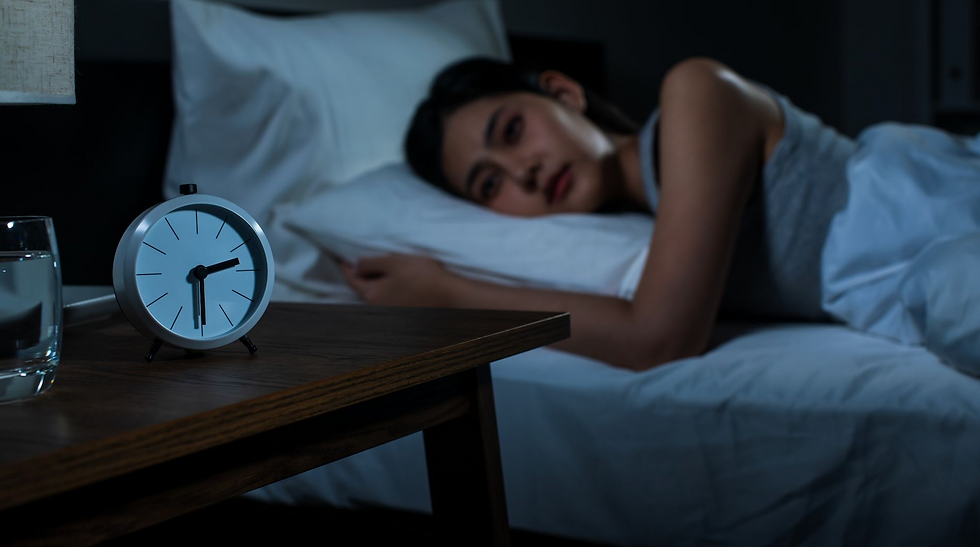
You’re exhausted by the end of the day.
Your body feels heavy.
Your eyes are tired.
And yet, the moment you lie down, your mind turns on.
If that’s you, let’s clarify something clearly:
This isn’t insomnia.
It isn’t a lack of relaxation skills.
And it isn’t your body “failing” to rest.
Sleep does not happen because you try harder.
Sleep happens when your nervous system feels safe enough to power down.

When Exhaustion and Alertness Exist at the Same Time
Sleep is not a switch you flip. It’s a physiological state that emerges when stress hormones fall and sleep hormones rise.
If you are exhausted but alert at night, your body is still producing cortisol rather than melatonin. Cortisol promotes vigilance. Melatonin supports sleep onset. These two hormones work in opposition and are tightly regulated by the nervous system (Goldstein & Walker, 2014).
Under chronic stress, the body can learn that nighttime is still a period of demand. Years of unpredictability, over-functioning, and constant mental engagement teach the nervous system to remain alert even when the body is depleted.
This is not conscious.
It is learned physiology.
Your body is doing what it has practiced.
Why Forcing Sleep Backfires
Many women respond to nighttime alertness by trying to control sleep:
Trying to relax harder.
Watching the clock.
Judging themselves for being awake.
But pressure increases arousal. And increased arousal sustains cortisol output, further blocking melatonin release (Van Dalfsen & Markus, 2018).
Sleep cannot be commanded.
It must be allowed.
The nervous system does not respond to force — it responds to predictability and safety.
Food to Implement: Tryptophan-Rich Foods
One way to support the transition from alertness to rest is through nutrition that supports sleep hormone production.
Tryptophan is an amino acid precursor to serotonin and melatonin. Adequate tryptophan availability supports the biochemical pathway involved in sleep onset and circadian regulation (Richard et al., 2009).
Evening sources include:
turkey
pumpkin seeds
oats
This is not about sedating the body.
It’s about supporting the physiology of rest.
Clinical note: If you are taking SSRIs or MAOIs, consult your healthcare provider before intentionally increasing tryptophan intake.

Why Predictability Is More Powerful Than Relaxation
The nervous system learns through repetition.
Creating one consistent bedtime cue — the same tea, the same stretch, the same breathing pattern — provides a signal of familiarity. Familiarity reduces vigilance.
Predictability tells the nervous system:
“We’ve done this before. Nothing bad happened.”
That message is often more regulating than any single relaxation technique.
A Reframe to Carry Forward
As you prepare for bed tonight, repeat:
“Rest is a biological response, not a personal failure.”
Let this land in your body.
Because when your nervous system feels safe, sleep follows naturally.
Moving Forward
Sleep problems are rarely about sleep itself.
They are about safety, rhythm, and learned patterns.
Each night you choose consistency over pressure, you teach your body something new.
You are not broken.
Your nervous system is learning.
This is how we stop normalizing stress.
This is how we begin living rooted in calm.
Tomorrow, we’ll talk about breathing — and how it can quietly keep anxiety alive all day without you realizing it.
References and Additional Reading
Goldstein, A. N., & Walker, M. P. (2014). The role of sleep in emotional brain function. Annual Review of Clinical Psychology, 10, 679–708. https://doi.org/10.1146/annurev-clinpsy-032813-153716
Richard, D. M., Dawes, M. A., Mathias, C. W., Acheson, A., Hill-Kapturczak, N., & Dougherty, D. M. (2009). L-tryptophan: Basic metabolic functions, behavioral research and therapeutic indications. International Journal of Tryptophan Research, 2, 45–60. https://doi.org/10.4137/IJTR.S2129
Van Dalfsen, J. H., & Markus, C. R. (2018). The influence of sleep on human hypothalamic–pituitary–adrenal (HPA) axis reactivity: A systematic review. Sleep Medicine Reviews, 39, 187–194. https://doi.org/10.1016/j.smrv.2017.09.002


Comments